
Advanced phishing: how a stealth attack hijacks Microsoft SharePoint and Cloudflare
This quarter, our analysts identified a highly targeted phishing operation leveraging Microsoft SharePoint and Cloudflare Workers to spread silently across.
An advanced phishing campaign detected by our team
This quarter, our analysts identified a highly targeted phishing operation leveraging Microsoft SharePoint and Cloudflare Workers to spread silently across organisations.
Why this attack is a real concern
- Exploitation of inter-company trust: an initially compromised account is used to target its professional contacts.
- No classic phishing indicators: attackers use genuine Microsoft file shares to establish trust. The malicious content is hosted on the SharePoint of a compromised organisation.
- Precise targeting: only corporate domains were targeted, with a focus on senior executives and accounts with high privileges.
- Subversion of Microsoft controls: the malicious link redirects to a Cloudflare Worker that dynamically loads a Microsoft authentication page hosted on a compromised WordPress site, creating a near-transparent phishing flow.
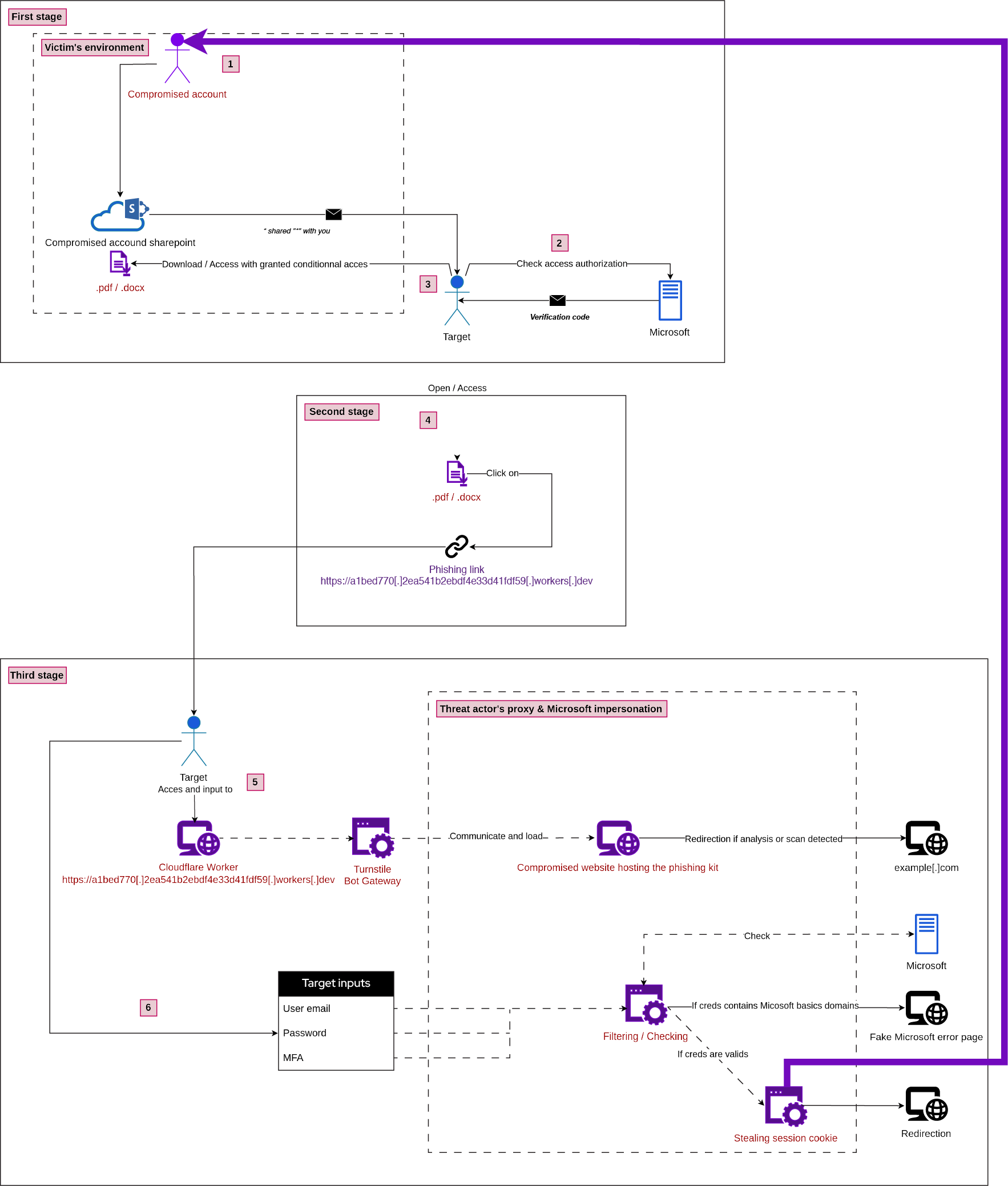
Silent, resilient and hard to detect
The campaign uses a layered infrastructure that obscures the attackers’ command and control. This approach allows the threat actors to:
- Evade EDR and reputation-based network filters.
- Propagate quietly across organisations via SharePoint and OneDrive sharing.
- Thwart automated scanning and simple detection heuristics.
- Capture credentials and session tokens in real time.
A level of sophistication consistent with organised groups
Observed TTPs suggest experienced threat groups or phishing-as-a-service operators. Notable techniques include:
- Adversary-in-the-Middle (AiTM) credential capture.
- HTML smuggling to deliver payloads or credential harvesters without easy detection.
- Use of bulletproof hosting and compromised CMS instances to host credential collection pages.
Taken together, these elements indicate a step change in the complexity of targeted phishing aimed at businesses.
Immediate recommendations for MSPs and security teams
- Monitor any suspicious external sharing of documents on SharePoint or OneDrive, even if it comes from trusted contacts.
- Block access to Cloudflare Workers domains that are not actively used within your organisation.
- Train users to detect early warning signs such as unusual Microsoft pages or inconsistent URLs.
- Reset passwords, multi-factor authentication (MFA), and active sessions on any account showing signs of compromise.