
What is a SOC? Definition and how it works
A SOC is not just antivirus; it is a dedicated structure for monitoring, detection and proactive response to security incidents. Definition and how it works.
The indispensable shield against digital threats
A SOC is not just an antivirus product. It is a complete, dedicated structure for monitoring, detection and proactive response to security incidents.
Understanding what a SOC is is the first step towards a robust, effective digital defence strategy, for your own organisation or for your clients.
What is a SOC (Security Operations Center)?
A SOC (Security Operations Center) is a centralised team combining cybersecurity experts, technology and processes. Its core mission is to continuously protect the information systems of an organisation.
In other words, it acts as the organisation’s immune system. Importantly, unlike a generic IT helpdesk, the SOC is exclusively focused on security.
Its role revolves around prevention, detection and response to security incidents. Technically, the SOC uses a sophisticated toolset to collect data, analyse it in real time and identify any sign of malicious activity.
The ultimate goal is to minimise the time between the appearance of a threat and its neutralisation. The team is trained to anticipate threats, not merely react to them after the fact. This is a fundamental SOC principle: it is proactive, not only reactive.
The technical role and components of a SOC
Technically, the effectiveness of a SOC relies on the integration and operation of several key technologies.
SIEM
The cornerstone of any SOC is the SIEM (security information and event management) system.
This is the tool that collects and aggregates security logs from across the network: servers, applications, firewalls and endpoint protection devices.
This centralisation of data is essential for event analysis.
SOAR
The team also uses SOAR (security orchestration, automation and response) solutions to automate repetitive tasks and accelerate response to common threats.
A modern SOC also incorporates user behaviour analytics, which helps to spot anomalies that may signal a compromised account or an insider threat.
The SOC team and their levels of expertise
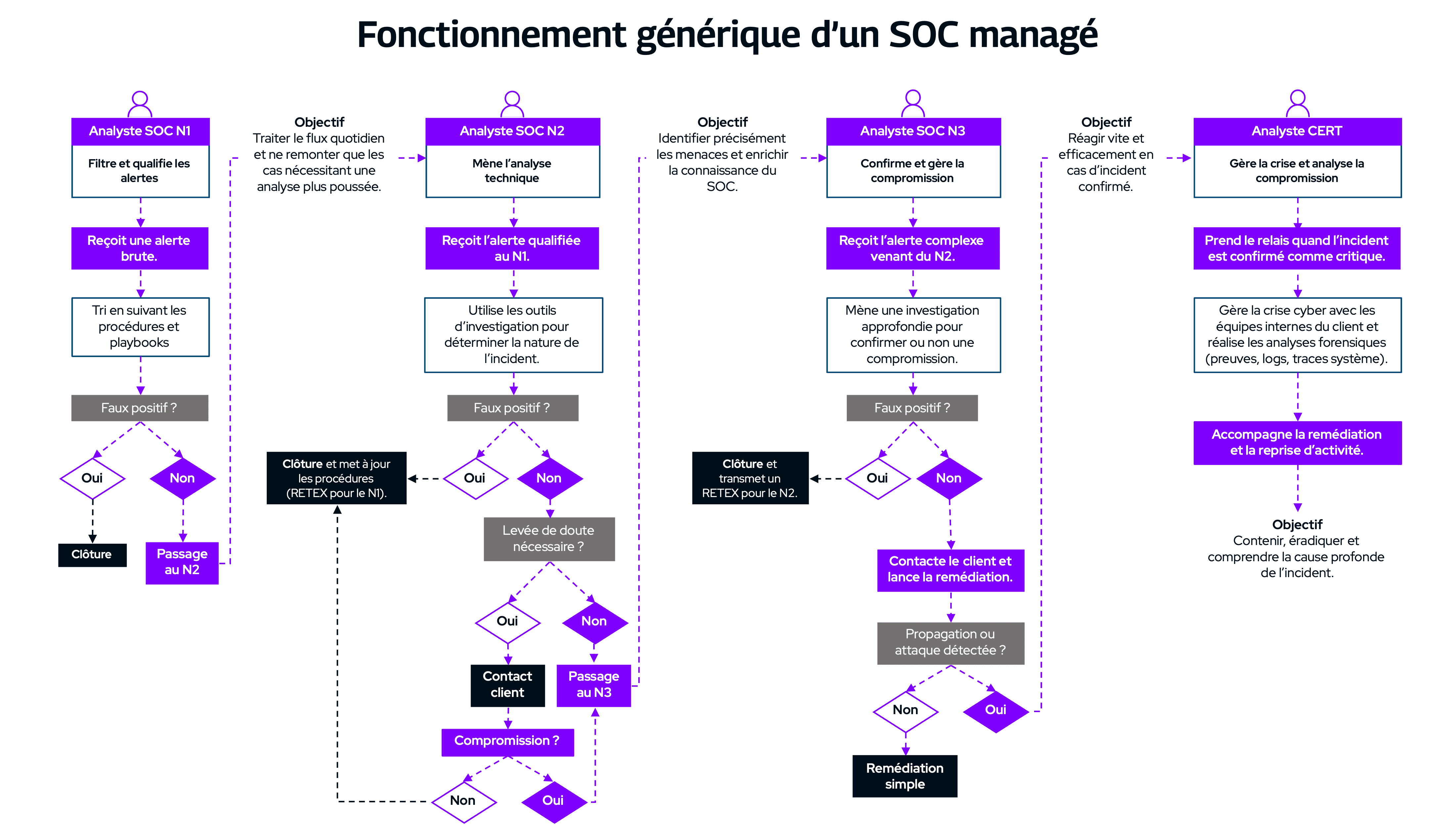
Beyond the tooling, a SOC is above all a matter of people and specialised skills. Teams are usually structured into several tiers to manage alerts efficiently, from the most generic to the most specialised. This SOC tiering is what drives operational effectiveness.
SOC analysts at the different tiers (1, 2 and 3) are tasked with investigating the alerts generated by these systems and separating the noise from the real incidents.
Tier 1 analyst
These are the first responders. They constantly monitor the security consoles, filter out false positives and triage the initial alerts. Their mission is to qualify the threat and execute the first standardised response procedures.
Tier 2 analyst
These experts handle alerts escalated by tier 1. They run in-depth investigation, using advanced tools to understand the nature, scope and origin of the attack. They are responsible for containing the incident.
Tier 3 analyst
Finally, tier 3 analysts are the most advanced cyber specialists. They lead threat hunting (the proactive search for undetected threats) and develop new detection rules. They handle the most complex and critical incidents and contribute to strategic monitoring of emerging threats.
From monitoring to incident management
The SOC’s work is structured around rigorous processes that deliver consistent, measurable security management. The first step is continuous monitoring.
This means constantly watching data flows and alerts to identify any anomaly. The tier 1 analyst is often the first to triage alerts and determine their severity and legitimacy.
Next comes threat detection (threat hunting). It is not only about reacting to alerts; SOC experts proactively search for threats that might have evaded detection.
Once a threat is confirmed, incident management takes over.
This phase covers in-depth investigation, isolation of the compromised system and remediation. Post-mortem documentation is essential to continuously improve the defences.
Which type of SOC should you choose?
Organisations can choose between different types and models of SOC, depending on their resources, size and needs. It is essential to know the two main models:
In-house SOC
The organisation builds and runs its own operations centre end to end. This requires a significant initial investment in personnel (expert salaries), tools (SIEM/SOAR licences) and infrastructure. This model offers full control and intimate knowledge of the network, but it is expensive and difficult to maintain 24/7.
Managed (outsourced) SOC
This is the “SOC as a Service” model. A specialist external provider takes over all or part of the SOC function. It delivers 24/7 expertise and state-of-the-art technology without the cost and difficulty of recruiting a full internal team.
It is the most accessible option for SMEs.
Why do you need a SOC?
As we have seen, relying solely on perimeter security tools (such as a simple firewall) is no longer enough in 2025.
The need for a SOC is now urgent for several fundamental reasons. First, the exponential increase in ransomware attacks.
According to the ANSSI 2024 report, the number of security events reported to ANSSI was much higher than in 2023. Ransomware attacks accounted for a quarter of the events reported to the agency through this network.
Regulatory compliance is also a legal obligation. The General Data Protection Regulation (GDPR) in Europe, for example, requires security measures to protect personal data.
Finally, if you are an MSP or systems integrator, this is just as relevant for you. By offering your clients a managed SOC service, you guarantee them 24/7 protection they could not maintain in-house.
This strengthens your portfolio and gives you a significant competitive advantage.
Securing the digital future with a SOC
A SOC is therefore far more than a collection of tools; it is a strategic investment in your organisation’s resilience.
It represents the human expertise and structured processes needed to face sophisticated adversaries. By centralising monitoring and threat response, a SOC drastically reduces the time to detect and act, minimising the potential impact of a cyberattack.
For any organisation that cares about its long-term viability and meets regulatory requirements, adopting a strategy that includes a SOC, whether in-house or managed, is not an optional expense but a fundamental layer of protection.
It is the guarantee that you can navigate the digital world with the confidence that experts are constantly watching over your most valuable assets: your data and your reputation.